The core of implementing the "dual carbon" national strategy is to monitor and control carbon emissions. Burning fossil fuels has always been the main way of primary energy in China, and it is also the main source of carbon dioxide emissions, accounting for about 88% of all carbon dioxide emissions. Among them, the emissions from the power industry account for about 41% of the emissions from the energy industry, and the task of reducing emissions is relatively heavy, with thermal power generation being the main source of carbon emissions.
There are generally two methods for carbon emission accounting in the power industry: emission factor method and actual measurement method. The emission factor method estimates carbon emissions based on different carbon emission coefficients corresponding to different fuels. The actual measurement method is to install a carbon dioxide monitoring instrument at the exhaust port, and calculate the real-time carbon emissions of the computer group based on the actual measurement data.
At present, the main accounting method for carbon emissions in thermal power plants adopts the emission factor method, which can result in significant estimation errors. With the opening of the national carbon emission trading market in July 2021, the accuracy requirements for carbon emissions of energy enterprises have been put on the agenda. Based on the existing flue gas emission information sub station system, technological transformation will be carried out to complete the construction of a carbon emission measurement and accounting system, which is a practical and effective path.
Beijing Zhongtai Huadian Technology Co., Ltd. has deployed PT3000 power plant flue gas emission information sub stations for more than 30 thermal power plants nationwide, providing technical and market foundations for the promotion of carbon emission measurement.
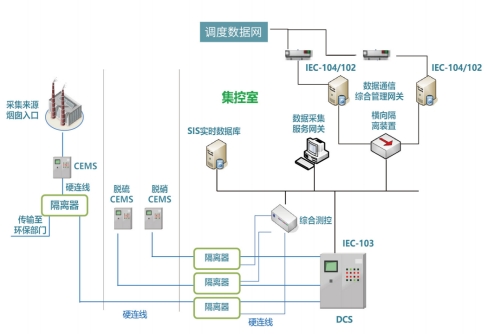
PT3000 is deployed in Safety Zone II of thermal power plants. The system collects CEMS data of environmental protection facilities such as desulfurization, denitrification, and dust removal, as well as equipment operating parameter data. It enters the dispatch data network through the main and backup data acquisition interface machines and is transmitted to the main station. The substation and main station use IEC-104 protocol for real-time data communication, and IEC60870-5-102 for supplementary historical data.
1. System composition
Comprehensive measurement and control, data acquisition network shutdown, data acquisition interface machine, isolation safety equipment
2. System architecture