"Virtual Power Plant" Ready to Go, Latest Case from Shanxi
With the continuous advancement of the "3060" dual carbon goals, the development of renewable energy has received unprecedented attention. Large-scale new energy power generation is being deployed. Energy storage, as an important configuration in the transformation of new power systems, is becoming increasingly mature in terms of policy support, technology verification, and business models. On July 15, 2021, the National Development and Reform Commission and the National Energy Administration issued the "Guiding Opinions on Accelerating the Development of New Energy Storage," which for the first time clarified energy storage as a key supporting technology for carbon peak and carbon neutrality, and defined the development goals and key tasks of energy storage. Combined with the centralized "new energy + energy storage" supporting development policies proposed by local governments and power grid companies in many provinces over the past 20 years, new energy storage has become an important means to solve energy transformation and is about to enter a period of rapid growth.
As one of the new business models for energy storage, virtual power plants play an important role in solving the problem of clean energy consumption and green energy transformation. They can improve energy services, achieve load forecasting, response allocation, real-time coordination control, and safe and healthy charging/discharging management of energy storage for distributed energy, and participate in power trading markets and demand response.
Since July, the "virtual power plant" field has begun to receive widespread attention. In the capital market, virtual power plants have become one of the hottest concepts, with some related concept stocks rising quietly. The persistent hot weather has caused power loads in many places to hit new highs, adding fuel to the popularity of "virtual power plants." According to CICC's calculations, China's virtual power plant industry is expected to reach a theoretical market space of 132 billion yuan by 2030. Why are virtual power plants so sought after? Why are countries competing for a first-mover advantage? Behind the popularity of virtual power plants is the wave of digital transformation of energy systems.
The key to opening the door to a new world of smart energy. In fact, the concept of virtual power plants did not emerge from nowhere; it has a solid development foundation. As early as 1997, Dr. Shimon Awerbuch proposed the concept of "virtual power plants" in his book "Virtual Public Utilities: Description, Technology, and Competitiveness of Emerging Industries." We can understand Virtual Power Plants (VPP) as a distributed multi-type energy resource aggregation management and operation model. Through advanced information communication technology and monitoring control technology, it aggregates and uniformly coordinates massive distributed power generation, demand-side, and energy storage resources, thereby participating in the power market and grid auxiliary services as a special power plant to obtain benefits.
With the support of high technology, the investment cost of a virtual power plant is only 1/10 to 1/8 of that of a thermal power plant, yet it can effectively address many challenges of the traditional power system: on the one hand, it can flexibly shift peaks and fill valleys, ensuring efficient and stable operation of the power grid; on the other hand, it can promote the consumption of new energy, reduce the phenomenon of "three curtailments," lower grid investment costs, and also provide subsidy income for participants such as enterprises and residents, achieving a win-win situation for all parties.
In recent years, as the concept of green and low-carbon sustainable development has gradually become a global consensus, and with continuous innovation in measurement, communication, intelligent scheduling decision algorithms, and information security protection technologies, as well as the rapid development of distributed power sources, energy storage, and electric vehicles, virtual power plants have shown increasing vitality and become a major future development direction for the global power industry.
Overview of Virtual Power Plants
By adjusting the load side/electricity consumption side, the electricity saved by a virtual power plant can participate in the spot electricity market. That is, the saved electricity is equivalent to generating that much electricity. The amount of electricity saved is determined through measurement. Although the power generation has not changed, the effect is similar to that of a power plant due to the adjustment of the load.
Dianfeng Energy Example:
If electricity demand is low and prices are low, the electricity can be stored through energy storage charging, while increasing the overall load of adjustable loads.
If electricity is tight, stored energy and distributed new energy power can be used as trading power, while reducing the aggregated adjustable load.
Most of the benefits go to energy-consuming enterprises, accounting for about 90% of the revenue. The operator collects service fees and a portion of the price difference, accounting for about 10% of the revenue.
Development of Virtual Power Plants in China
Previously, foreign markets did more, as foreign electricity markets are fully market-oriented.
Current Main Models
In China, a true implementation occurred in 2019, when North China Grid Company first conducted a virtual power plant pilot project focusing on peak shaving and valley filling, participating in the auxiliary services market.
Up to now, virtual power plants mainly participate in the power auxiliary services market proposed by grid companies/grid dispatchers, focusing on peak shaving and valley filling business.
Current model: Establish a platform to aggregate various adjustable load resources. Based on the grid's need for peak shaving and valley filling, online reporting, plan issuance, and execution feedback are carried out, similar to an online work order dispatch system. The grid provides dispatch instruction plans and demand response control plans, issuing the plans a few days/weeks in advance. Load integrators and virtual power plant operators inform customers which time periods to stop loads and reduce electricity consumption.
Model Transformation
With the opening of the spot trading market, virtual power plants have stronger, faster, and more precise adjustable capabilities than thermal power plants, highlighting their advantages. In this context, the business model of virtual power plant operators is not only to participate in the auxiliary market but also to profit through spot and market-based trading mechanisms.
Virtual power plant operators sign contracts with customers, who authorize which devices can serve as adjustable loads and to what extent the load can be adjusted and controlled during peak load times. This allows for remote adjustment of equipment via switches. Alternatively, instructions can be sent to customers through the platform for them to control on-site.
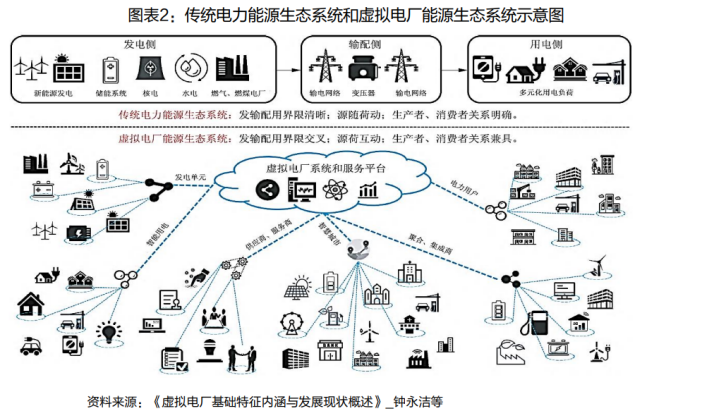
A virtual power plant is a smart energy system that aggregates one or more controllable resources such as adjustable loads, energy storage, microgrids, electric vehicles, and distributed power sources from different spaces, achieving autonomous coordinated optimization control, and participating in power system operation and electricity market trading. It can act as a "positive power plant" to supply power to the grid or control adjustable loads for peak shaving, or as a "negative power plant" to increase load consumption for valley filling.
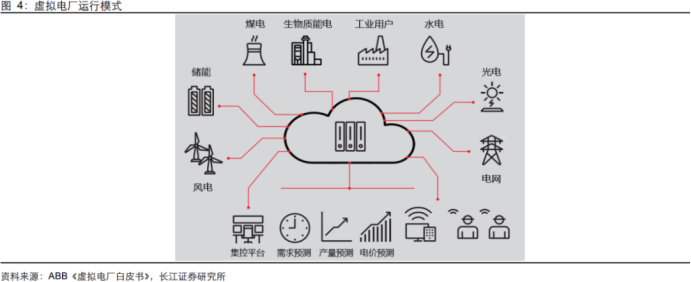
The core idea of a virtual power plant is to aggregate various distributed adjustable power sources, controllable loads, and energy storage, and to form a virtual power plant through digital means for unified management and scheduling. Therefore, a virtual power plant is essentially a software platform system that aggregates existing distributed resources and participates in the electricity market through coordinated control.
Virtual Power Plant Principle: Aggregate distributed energy, shift peaks and fill valleys, participate in electricity market.
A virtual power plant can be seen as an extension of demand response. Demand response mainly focuses on peak shaving, targeting user loads; a virtual power plant addresses both peak shaving and valley filling, partially possessing energy storage characteristics, encompassing sources, grids, loads, and storage.
Recent Developments
1. The pace of electricity market liberalization is accelerating, and spot electricity trading is to be fully implemented.
2. In early July, Shanxi Province issued the first virtual power plant rules and implementation plan, stating that virtual power plants composed of distributed resources, power sources, energy storage, and adjustable load resources can directly participate in the Shanxi electricity spot market.
3. Recently, the five provinces under China Southern Power Grid achieved inter-provincial spot electricity trading and full marketization. The highest electricity price in CSG can reach 1.5 yuan, and the lowest can be 0 yuan.
4. State Grid electricity spot market: pilots started in 2019, initially in 8 provinces, with 5 new provinces added this year. Starting in the second half of this year, it is estimated that the third batch of pilots will be fully liberalized.
Main Equipment of Virtual Power Plant Structure:
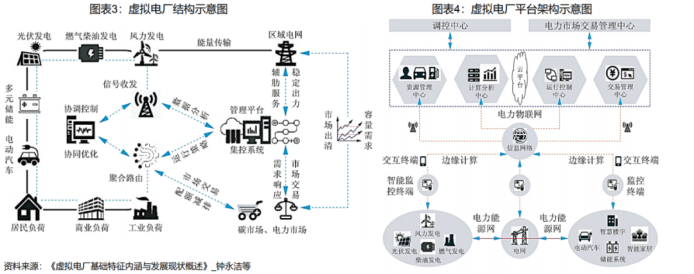
1. Collaborative control / digital control platform
2. Regulation and coordination of controllable loads: terminal collection equipment
3. Controllable switches for remote adjustment of adjustable loads
4. Ensuring stable operation of the grid and loads: requires supporting power electronic equipment, energy storage devices, etc.
Core of Virtual Power Plant Business Development
Customer scale and understanding of electricity sales and spot market trading rules. Load-side customer resources: with a certain scale of customers, the impact of transactions on the market will be greater, and predictions will be more accurate.
Spot market trading rules are determined, and models are built according to these rules.
Model accuracy, prediction/bidding strategy accuracy, load forecasting technology rely on data support and require data training. The larger the customer scale, the more accurate the trained model.
Technology
Load forecasting, trading strategy formulation, model algorithms, artificial intelligence, model training, and other technologies.
Based on power generation and consumption, using model algorithms to accurately predict the overall load situation at the provincial level for the next phase, enabling more precise trading.

Degree of Electricity Spot Market Openness Enterprises Participating in Virtual Power Plants
Category 1: State Grid, China Southern Power Grid, Energy Groups
These companies previously participated in virtual power plants in the auxiliary services market and are now gradually transitioning to the electricity spot trading model.
Category 2: Software and Technology Service Enterprises
1. Enterprises combining energy with internet/digitalization. Collaborating with grid companies and power generation groups, they build capabilities, refine platform algorithms and models, and gain access to customer resources. Such enterprises can also participate in the electricity spot market through virtual power plants in the future.
2. Pure internet companies like Alibaba, Tencent, Huawei, etc., are also laying out virtual power plants, enhancing corresponding technical capabilities and products.
These enterprises have strong technical capabilities in software development, model algorithms, etc., and can provide technical services or directly participate in trading.
Category 3, the largest category: Electricity Sales Companies
Electricity sales companies can engage in wholesale and retail of medium- to long-term electricity, and on the other hand, can act as load integrators, build their own virtual power plants, and participate in the electricity spot trading market.
Virtual Power Plant Profit Model
Original model: Peak shaving and valley filling, according to grid dispatch requirements.
Current model:
Not only participate in the auxiliary services market but also in the spot market.
Participation in the spot market generates profits mainly from price differences in spot trading.
The spot market pricing mechanism is based on the relationship between electricity supply and demand. It can control and coordinate aggregated adjustable loads, while also adding energy storage and distributed energy to form a collective.
If the ability to predict the overall load in a region is strong, the formulated bidding strategy will be more advantageous, and the price difference will be larger. Specific profitability depends on the frequency and activity of electricity spot trading, the regional electricity supply and demand relationship, etc.
Virtual Power Plants in China Are on the Rise
Virtual power plants have not been present in China for long, and their development in recent years has been rapidly growing. With the introduction of the national 3060 dual carbon goals, the construction of new power systems with new energy as the mainstay is imminent. Virtual power plants, with their ability to coordinate source, load, and storage resources to participate in the electricity market, are expected to play an important role. Actively guided by national and local policies, virtual power plants are facing historic development opportunities. Recently, many securities firms have issued research reports stating that virtual power plants are on the eve of a major breakthrough.
"Guangdong, Zhejiang, Jiangsu and other places may become the fastest-growing regions for virtual power plants in China," according to an analysis report by Northeast Securities. "On the one hand, these provinces have high electricity demand and high risk of power shortages, making the development of virtual power plants urgent; on the other hand, these regions have more controllable loads and are qualified to participate in demand response." These provinces mentioned had already implemented multiple virtual power plant demonstration projects by this time last year, becoming pioneers in the development of energy interconnection in China.
On June 21, 2021, the country's first county-level virtual power plant - Pinghu Virtual Power Plant in Jiaxing, Zhejiang - was put into practical application for the first time. The project aggregated 6 major categories and 18 sub-categories of source, storage, and load resources, including parks, photovoltaics, cogeneration self-provided power plants, energy storage power stations, and 5G base stations, achieving full coverage of adjustable resources by street and by type, forming a resource pool capable of providing a total adjustable load of over 200 megawatts for day-ahead, intraday, and real-time operations.
Just three days later, the country's first "Low-Carbon Digital Energy Interconnection Platform" was officially launched in Changzhou, Jiangsu. The platform can monitor the carbon emissions of electricity generation in real time, mobilize resources such as new energy power plants, charging stations, energy storage devices, and adjustable loads in the grid, promote the priority consumption of green energy, and achieve energy saving and carbon reduction.
In August of the same year, the Ningbo Virtual Power Plant participated in the first auxiliary service market transaction organized by Zhejiang Province and successfully won the bid, marking the official start of the power auxiliary service market transaction process for the Ningbo Virtual Power Plant.
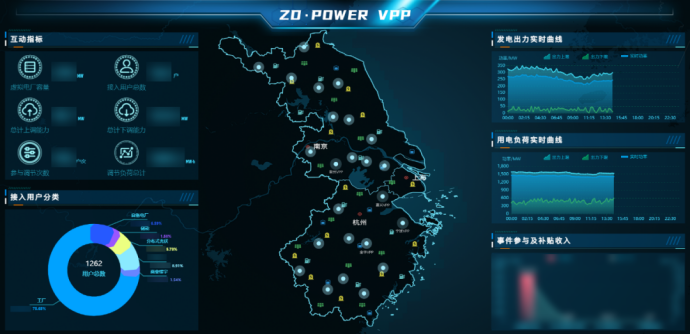
Behind these successful cases is the same low-key virtual power plant operator——Zeda Energy. Relying on the core team of Zhejiang University, Zeda Energy has been focusing on the research and development of virtual power plant technology since 2017, possessing more than dozens of VPP-related patents. It is the first operator in China to achieve full-link operation of virtual power plants. What is less known is that Zeda Energy's virtual power plant (ZD·POWER VPP) has now spread across the Yangtze River Delta region, with multiple virtual power plants constructed and operated in various cities and districts throughout Zhejiang and Jiangsu provinces.
"Virtual power plants can effectively improve grid security levels and promote green and low-carbon energy transformation. They are of great significance not only for the construction of new power systems but also for the sustainable development of our entire society. At the same time, they can help industrial and commercial users save energy and reduce carbon, explore flexible energy consumption space, improve energy efficiency, and manage their own energy consumption well." Dianfeng Energy: "It is foreseeable that the participation of virtual power plants in the electricity market will become a new trend in the future. From a market perspective, in the context of national low-carbon transformation and the connection of a large amount of clean energy to the grid, flexible adjustability will become a scarce resource. Whoever possesses such flexible adjustability will be able to secure a place in the future market."
In the wave of global energy structure transformation, virtual power plants truly achieve the aggregation of scattered resources and the ability to overcome rigidity with flexibility, promising to become the key to opening the door to a new world of smart energy. Globally, the technical obstacles to the development of virtual power plants have basically been removed. How to better achieve commercialization is a more complex proposition, which requires the joint efforts of governments, grids, enterprises, residents, etc., to actively explore market mechanisms that balance the interests of all parties, and to build a clean, low-carbon, safe, reliable, intelligent, and open energy internet——We believe this wave will lead us to a better future.
Currently, domestic renewable energy is developing rapidly, short-term peak electricity demand is continuously rising, and coupled with the impact of extreme weather, this has led to tight electricity supply and demand in some regions. The grid exhibits distinct "dual-high" and "dual-peak" characteristics, with insufficient reserve capacity. In extreme cases, the grid reserve capacity gap could reach 200 million kilowatts by 2030.
As an important means to enhance the regulating capacity of the power system, virtual power plants will play a significant role in alleviating electricity shortages, with broad market prospects. To this end, the author has conducted in-depth research on the development status of virtual power plants both domestically and internationally, deeply analyzed and compared typical domestic and foreign cases, predicted and judged the development prospects of virtual power plants in China, and put forward relevant suggestions for their development, aiming to provide reference and inspiration for industry managers and investors.
Development Status of Virtual Power Plants at Home and Abroad
A virtual power plant can be understood as a smart energy system that aggregates one or more types of resources such as adjustable (interruptible) loads, energy storage, microgrids, electric vehicles, and distributed power sources from different spaces, achieving autonomous coordinated optimization control, and participating in power system operation and electricity market trading. It can act as a "positive power plant" to supply power and shave peaks, or as a "negative power plant" to increase load consumption for valley filling. It can quickly respond to instructions to ensure system stability and obtain economic compensation, or it can participate in various electricity markets such as capacity, energy, and auxiliary services to gain economic benefits, similar to a power plant. Currently, foreign virtual power plants have achieved commercialization, while domestic ones are still in the early development stage, primarily focused on research and demonstration.
Development Status of Foreign Virtual Power Plants
The theory and practice of virtual power plants (VPP) are mature in developed countries, each with its own focus. Among them, the United States focuses on demand response of controllable loads to participate in system peak shaving and valley filling; Japan focuses on user-side energy storage and distributed power sources to participate in demand response; Europe focuses on the aggregation of distributed power sources to participate in electricity market trading.
Germany's virtual power plants have achieved full commercialization. A main business of German virtual power plant operators is to sell electricity generated by medium-sized renewable energy power plants of over 100kW in the wholesale market, optimizing their electricity sales in the day-ahead market, making these power plants virtual power plant resources. In addition, virtual power plants also benefit highly flexible units such as biomass power and hydropower from the day-ahead market and balancing market. Besides renewable energy power plants, gas cogeneration, battery storage, emergency generators, and demand response can also serve as virtual power plant resources.
The main application scenario for German virtual power plants is to use the flexible electricity prices in the electricity market to guide the optimization of power generation and consumption costs within the power plant's jurisdiction and optimize trading revenue. In Germany, upstream, midstream, and downstream products supporting virtual power plants have gradually become complete. In addition to directly participating in electricity market transactions, virtual power plants share premium portions with customers, participate in grid ancillary services (secondary and tertiary frequency regulation) to collect service commissions, and offer corresponding electricity sales packages for different users. Depending on the operator, German virtual power plants can be roughly divided into three types: independent virtual power plant operators, large power companies (multinational, regional, and municipal enterprises), and new market entrants.
China's virtual power plants are still in the initial stage. According to the "Overview of the Basic Characteristics, Connotation, and Development Status of Virtual Power Plants," since 2019, China has successively implemented virtual power plant demonstration projects.
Since 2021, China has issued a large number of policies to support the development of virtual power plants, and some provinces and cities have also introduced clear implementation plans or subsidy standards. For example, in July 2021, Guangzhou City issued the "Guangzhou Virtual Power Plant Implementation Rules," which clarified the subsidy standards for virtual power plants participating in grid regulation, accelerating the market recognition of virtual power plants from the perspective of the auxiliary services market. In June 2022, the Shanxi Provincial Energy Bureau issued the "Virtual Power Plant Construction and Operation Management Implementation Plan," clarifying the types, market entry processes, technical specifications, and other requirements for virtual power plants, becoming the first provincial-level virtual power plant implementation plan.
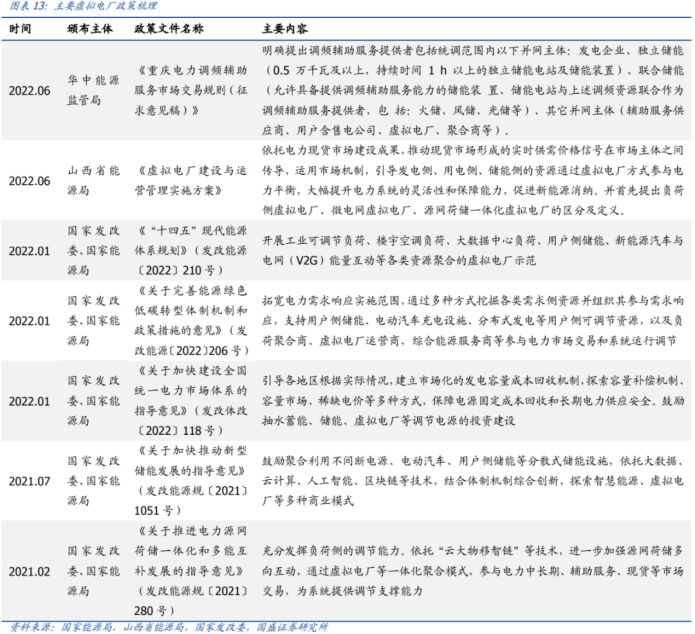
With increased policy support for virtual power plants, power information-related targets will widely benefit from the development of virtual power plants. From a policy environment perspective, in recent years, many provinces, guided by government, have carried out a series of demonstration projects by the two major grid companies, with participation in demand response as the main operation and profit model, continuously promoting the development of virtual power plants. Various regions have generally introduced auxiliary service market policies to guide virtual power plants to participate in system peak shaving and frequency regulation. Against this backdrop, demonstration projects are actively exploring market-oriented operations and innovating feasible business models, which is expected to drive the rapid and sustainable development of domestic virtual power plants.
Development Status of Domestic Virtual Power Plants
Currently, domestic virtual power plants are still in the initial stage, primarily focused on pilot demonstrations. In China, demand response is the mainstream, and virtual power plants can be understood as an upgraded version of demand response. The focus of virtual power plants is to increase supply, which can lead to reverse power flow phenomena, while demand response emphasizes load reduction and does not cause reverse power flow. Depending on external conditions, the development of virtual power plants can be divided into three stages: invitation-based, market-based, and cross-space autonomous scheduling-based virtual power plants. Currently, China's virtual power plants are in the transition stage from invitation-based to market-based, presenting the following characteristics:
First, virtual power plant policies still need improvement, and there is an urgent need for specialized policies at the national and provincial levels.
Currently, there is no specialized national-level virtual power plant policy. At the provincial level, only Shanghai, Guangdong, and Shanxi have issued the "Approval for Further Carrying out Shanghai Power Demand Response and Virtual Power Plant Work" (September 16, 2020), the "Guangzhou Virtual Power Plant Implementation Rules (Draft for Comments)" (June 30, 2021), and the "Virtual Power Plant Construction and Operation Management Implementation Plan" (June 23, 2022), respectively.
Policies related to virtual power plants mainly involve demand response and auxiliary services. To mobilize user-side resources to respond to the power system, building on the demand-side pilot in 2013, 14 provinces and regions including Shanghai, Jiangsu, Guangdong, Zhejiang, Shandong, and Henan have introduced new demand response policies, with financial compensation coming from surplus funds such as peak electricity prices and new energy trading.
At the same time, auxiliary service policies are also being introduced in various provinces. Currently, provinces and regions such as Jiangsu, Hubei, Liaoning, Hunan, Henan, Anhui, Fujian, Guizhou, Jiangxi, as well as five major regions including Northeast and East China, have introduced or revised power auxiliary service policies. Concurrently, energy authorities in North China, Central China, Zhejiang, Jiangsu and other places have opened up the identity of third-party entities such as virtual power plants and user resources to participate in peak-shaving auxiliary services.
Second, virtual power plants are generally in the pilot demonstration stage, and there is a lack of a unified virtual power plant platform at the provincial level.
The most distinctive provinces currently conducting virtual power plant pilots are Shanghai, Jibei, Guangdong, and Shandong. Jiangsu mainly participates in the demand response market rather than a strict virtual power plant. Shanghai mainly conducts virtual power plant pilots aggregating commercial building air conditioning resources. Jibei mainly participates in the North China auxiliary service market. Guangdong mainly focuses on point-to-point project testing. The Shandong pilot project aims to carry out transactions in three varieties: spot, reserve, and auxiliary service markets, complete the connection between spot and demand response mechanisms, and build a virtual power plant operation platform.
The main market entities for virtual power plants include Jibei Electric Power Company, Shanghai Power Supply Company, Hefei Power Supply Company, State Grid Integrated Energy Service Group Co., Ltd., China Southern Power Grid Company, State Power Investment Corporation, etc. Currently, there is a lack of a unified virtual power plant platform at the provincial level. Existing virtual power plant platforms are uneven, lacking uniform standards and interfaces. They are mainly self-built by different market entities, but they are not uniformly connected to a unified provincial/city/regional virtual power plant platform to achieve interactive control with the main grid.
Third, most virtual power plant pilots have achieved preliminary user energy consumption monitoring, but few projects have achieved optimal scheduling of virtual power plants and closed-loop control of distributed energy.
Virtual power plant technology mainly includes metering technology, communication technology, intelligent scheduling decision technology, and information security protection technology. In the process of controlling various distributed energy generation equipment, energy storage systems, and controllable loads in a virtual power plant, coordinated control is key and difficult, but this function still needs improvement.
From the perspective of aggregated resources, they are mainly load-side adjustable resources, especially industrial loads, commercial building air conditioning loads, and thermal electric storage heating, plus resources such as charging piles and energy storage vehicles. However, large-capacity, widespread renewable energy sources like distributed photovoltaics are not controllable, and accurate forecasting capabilities are insufficient.
Fourth, the business model of virtual power plants is still unclear, and all are in the exploration stage. The current virtual power plant business model is not clear, mainly participating in the market through price compensation or policy guidance.
Jiangsu mainly participates in demand response for peak shaving and valley filling, ranking among the top in China in terms of practice scale, frequency, and variety. Shanghai mainly participates in three types of transactions: demand response, reserve, and peak shaving, leading the country in the number of load types, the highest proportion of valley filling load, and the largest number of participating customers. Jibei mainly participates in the peak-shaving-oriented auxiliary service market, primarily focusing on valley filling services to promote the consumption of renewable energy such as wind power and photovoltaics, representing a rare fully market-oriented operation model. Guangdong mainly participates in the demand response market. Although its frequency regulation auxiliary market is already operating, user-side resources have not yet been included in frequency regulation auxiliary services due to unresolved technical difficulties. The Shandong pilot mainly participates in spot energy, reserve, and auxiliary service market transactions, completing the connection between price-guaranteed participation in day-ahead spot and demand-side management mechanisms, gradually transitioning from policy subsidies to marketization.
Virtual Power Plant Business Models
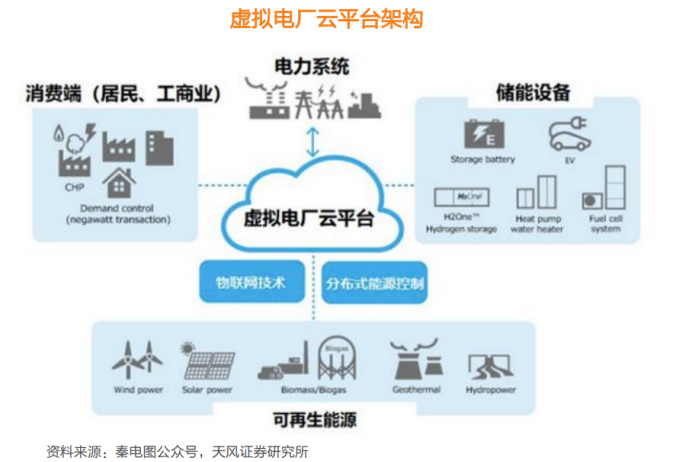
Business Model 1: Software System Platform Construction within the Grid System
Build a virtual power plant cloud platform within the grid system based on software, connecting the power system, and linking consumer-side (residential, industrial and commercial), energy storage devices, and generation-side renewable energy through IoT technology and distributed energy control technology.
Business Model 2: Valley Filling and Peak Shaving Electricity Subsidy Operation Sharing
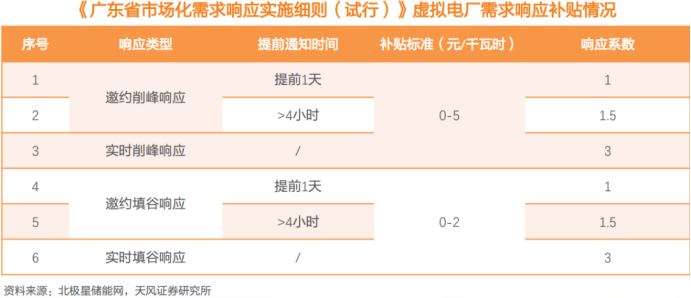
Operation sharing market calculation method: Using the February 2021 "Guangzhou Virtual Power Plant Implementation Rules (Draft for Comments)" as an example: ① Response electricity target: The goal is to guide users to achieve peak shaving and valley filling by carrying out demand response, gradually forming a demand response capacity accounting for about 3% of the city's maximum dispatch load. ② Response subsidy: Power users and load aggregators can apply to participate in demand response. Demand response is divided into two types: invitation and real-time. Subsidy cost = effective response electricity × subsidy standard × response coefficient. Peak shaving subsidy up to 5 yuan/kWh, valley filling subsidy up to 2 yuan/kWh.
Business Model 3: Market-oriented Closed Loop as an External Supplement to the Main Grid
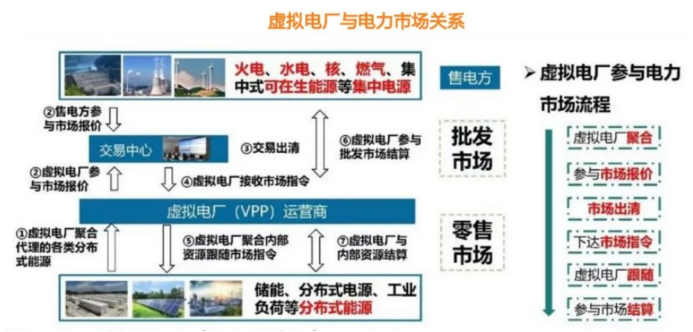
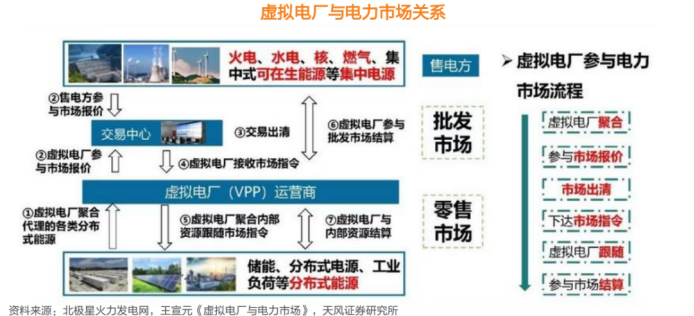
In the future, virtual power plants may form a market-oriented closed loop linking generation and consumption, becoming an important participant in the external electricity market of the main grid system. Virtual power plants participate in the electricity market through processes such as virtual aggregation, market bidding, market clearing, issuing market instructions, virtual power plant following, and participating in market settlement. In the future, if combined with market-based power generation from distribution networks, microgrids, and distributed photovoltaics, it is expected to form a market-oriented closed loop of "distribution" + "electricity sales" outside the main grid system.
Virtual Power Plant Competitive Environment
As a highly capital, resource, and technology-intensive industry, virtual power plants have certain barriers to entry. However, due to the significant development potential of the industry, many enterprises from various fields have entered, resulting in diverse enterprise types. Market concentration is not high, and competition is relatively fierce.
Below, we mainly analyze the enterprises related to the virtual power plant industry chain from the perspective of midstream resource aggregators.
1. Information sector enterprises in the power grid field
Relying on experience and technology in the power and communication fields and the abundant information and communication resources of grid companies, they have inherent advantages in carrying out virtual power plant business and have become the main force in current demonstration projects, such as State Grid Information & Telecommunication, NARI Technology, and Yuanguang Software.
2. Solution providers in smart energy and IT fields
Mainly relying on technological reserves in system development, control measurement, digital transformation, etc., in the energy field to achieve virtual power plant system optimization, and achieving resource integration and business expansion through cooperation with enterprises in the energy field, such as Hengshi Technology, Guoneng Rixin, Huawei, East Group, Jinzhi Technology, and Clou Electronics.